
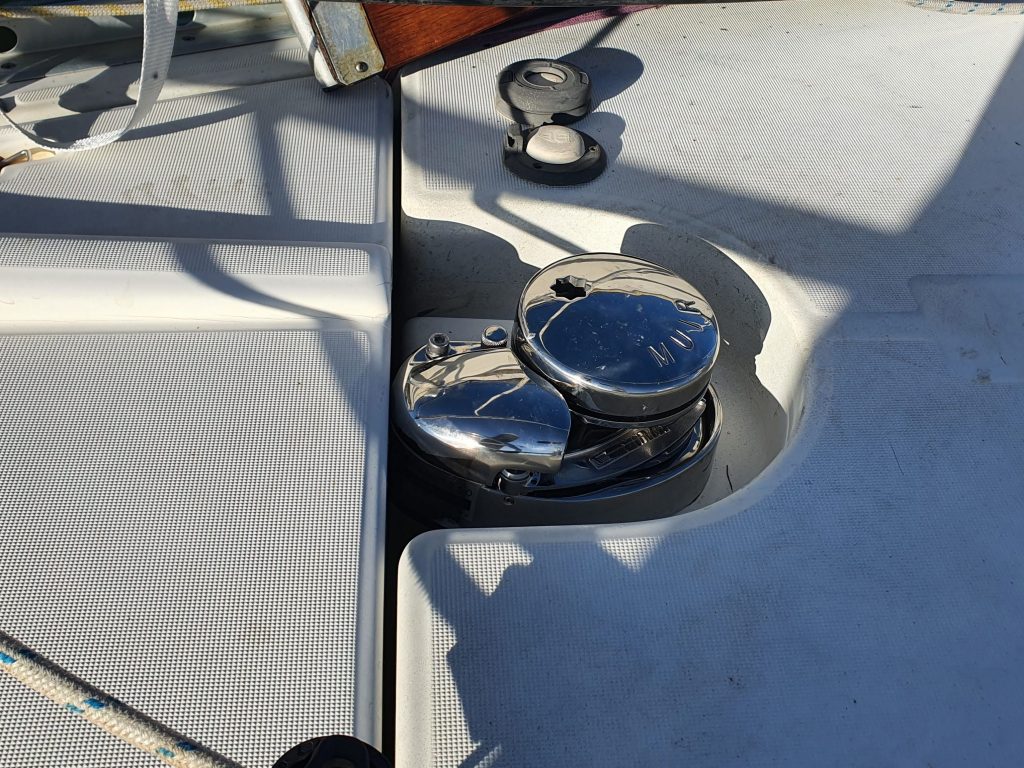
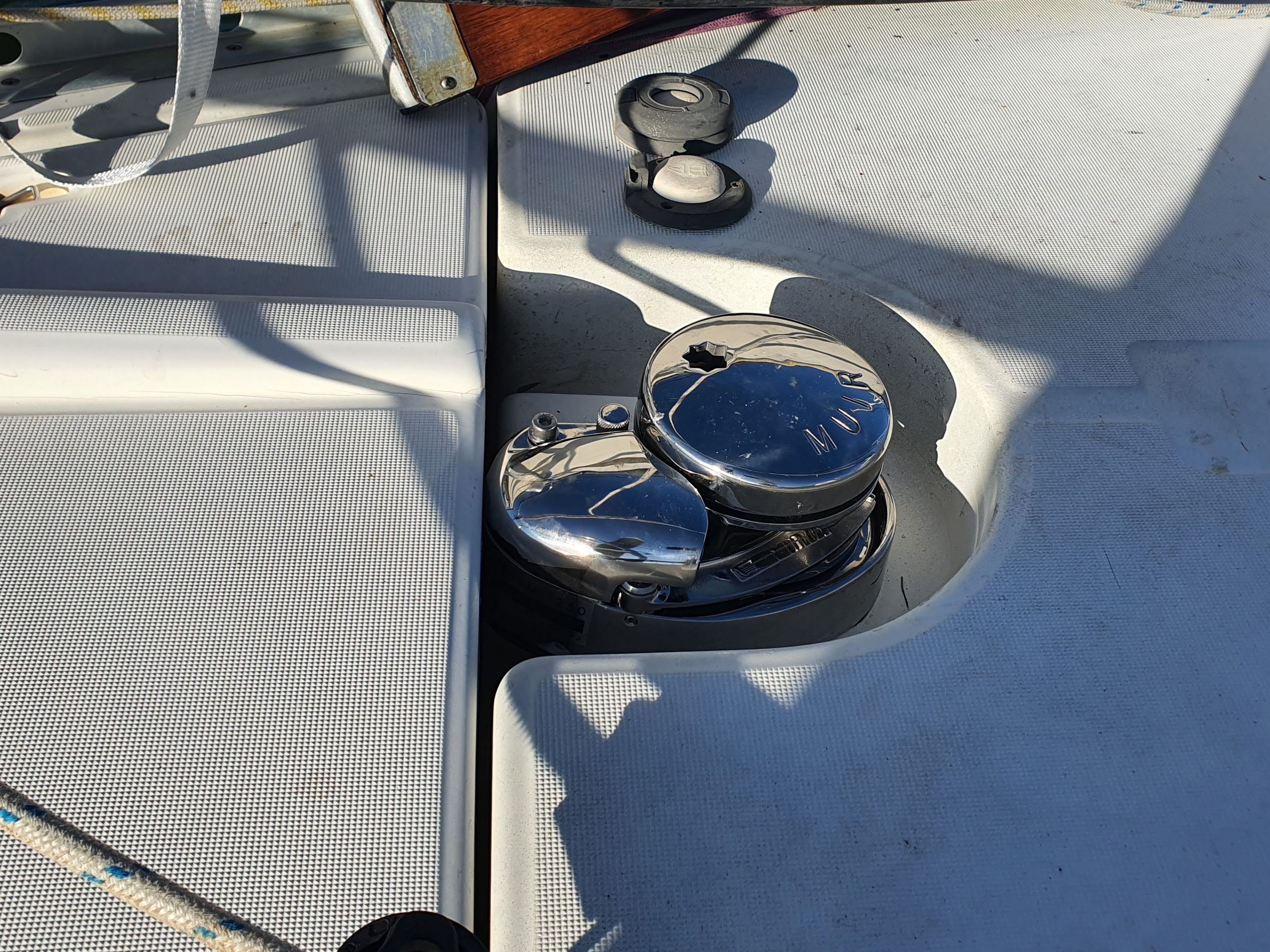
One of the first projects we did on our boat was to get windlass back in working order. The boat had an old Muir Atlantic 850, which was seized and no longer functioning. Our ground tackle consisted of a 16kg (35lb) Manson NZ plough anchor and 30m of 10mm chain.
The considerations that had to be taken into account were:
- The boat
- Windlass specifications
- Chain characteristics
- Availability
The Boat
Our boat had a 600 Watt 12v windlass. Ideally we wanted to keep a system similar in order to avoid running or replacing wire. With direct current the cables have to be sized appropriately in order to avoid voltage drop or over heating. Here is an example:
The displacement and size of the boat needs to be accounted for. This can be found on all the manufacturer websites. For instance, a Muir Storm 1250 windless is recommended for heavy displacement boats that are between 10m and 12m long, and up to 14m for light displacement vessel.
Our boat is 11m (36-foot) and it is considered a light displacement at 6 tons (see definition of Disp./Len. ration = 189.78).
Muir Storm 850 would work for us, but we went with the 1250 based on the rest of the considerations.

Windlass specifications
We looked at a lot of different vertical windlass models that would be adequate for our boat size. We started by looking at what other owners have been using through forums and YouTube videos. The physical size of the motor and gear box matter as well, some new models have amazing specifications but wouldn’t have fit in the compartment.
My requirements were to have a manual override (to drop and bring the anchor up) and allow for enough payload.
| Cat. | Muir Atlantic 850 | Muir Storm 1250 | Lewmar v2 | Lewmar cpx2 | Lewmar vx2 | Lofrans x2 | Lofrans x2 | Quick dp2 |
|---|---|---|---|---|---|---|---|---|
| Working load (kg) | 96 | 125 | 163 | 163 | 213 | 115 | 150 | 100 |
| Max pull (kg) | 386 | 500 | 650 | 650 | 850 | 850 | 1000 | 680 |
| Wattage | 600 | 1000 | 700 | 700 | 700 | 800 | 1000 | 700 |
| Amperage | 80 | 100 | 80 | 80 | 120 | 90 | 135 | 95 |
| Engine connectors | 2 | 3 | 3 | 2 | 2 | 3 | 3 | 3 |
| Dimension (mm) | 245 | 251 | 239 | 248 | 331 | 260 | 260 | 300 |
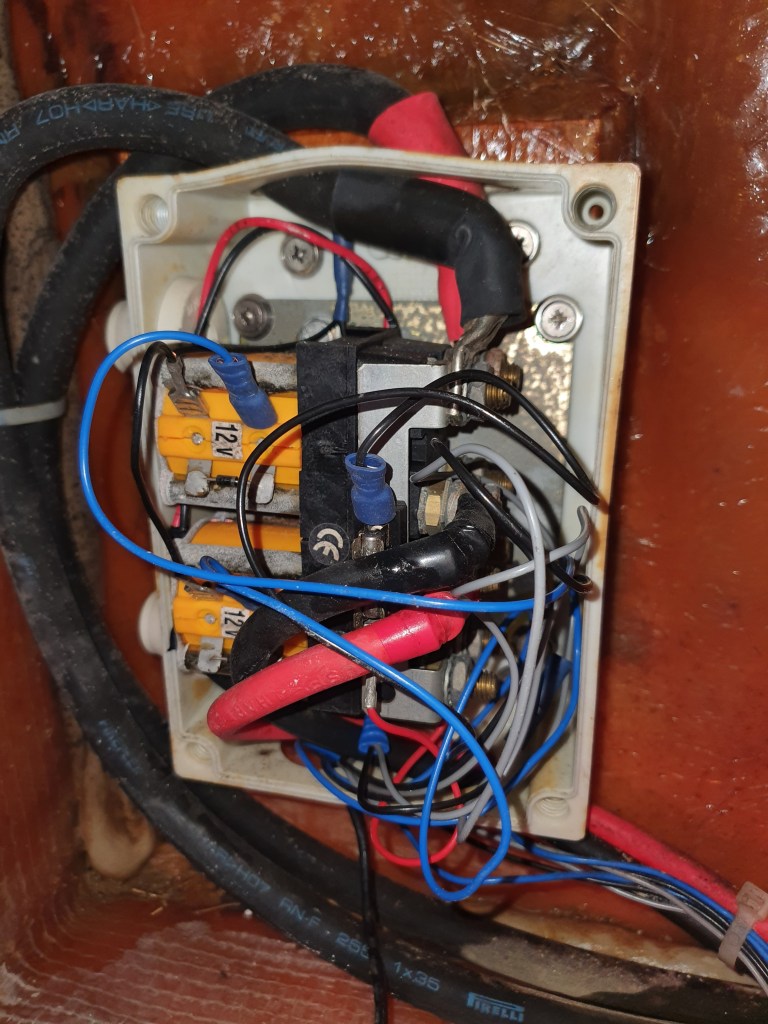
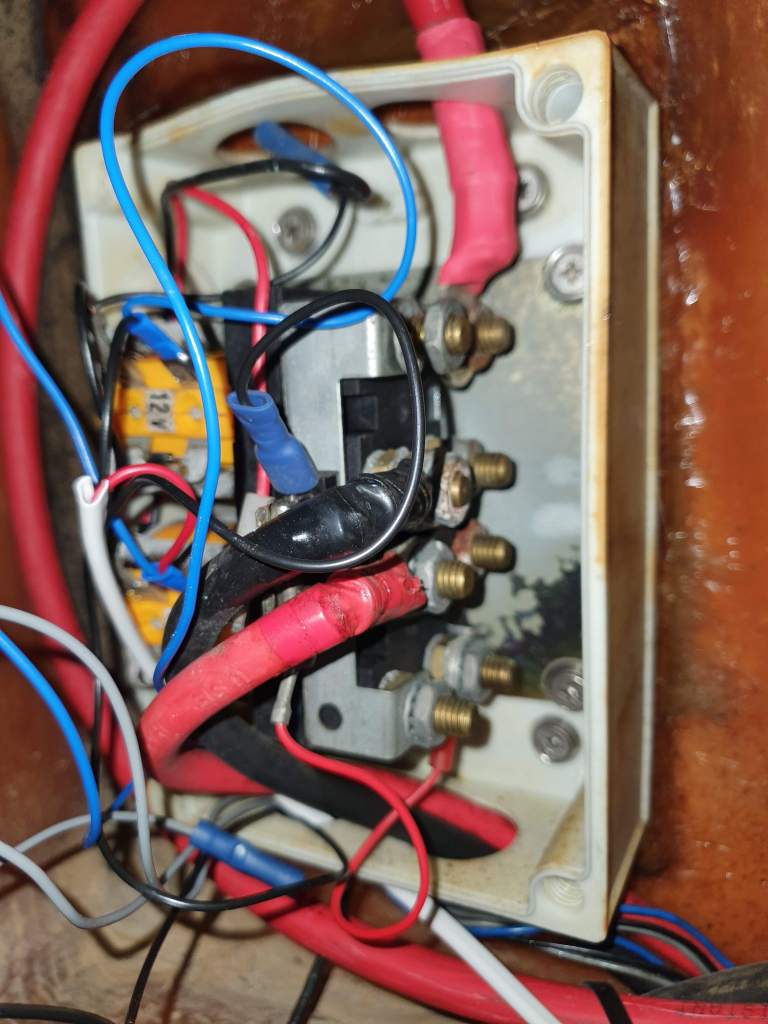
Our solenoid looked to be from another generation, but it hasn’t had any issues. We just had to learn how the wiring worked.
Chain characteristics
What length of chain do we need?
This question quickly became important in the selection of the windlass. The longer chain you have the heavier your ground tackle is. A 10mm chain is 1.5kg per meter where a 8mm chain is 0.9kg per meter. Chains also have different strength grade (L, G40, G43, G70, G73), materials (galvanised, stainless steel), and dimensions (DIN vs ISO).
The length defines where you can anchor. We usually follow the 4:1 ratio or 4m chain per 1m depth.
Given that, with 30m chain you can anchor in less than 10m depth. While this was practical if we were going to always be in the Moreton Bay area, it wouldn’t be great for voyages elsewhere. The further your anchorage is from the beach the deeper you can expect it to be.
The strength grade defines whether the chain stretches and what the working and breaking loads are. I ended up using the following website to define what to get: http://alain.fraysse.free.fr/sail/rode/tackle/tackle.htm
The materials primarily influence the price. A stainless steel chain will eventually sit better in your chain locker as chain links slide on each other.
Dimensions of the links will define the windlass chain gyspy.
This was really challenging to get information on. Muir would not confirm that their windlass 8mm would work with a chain vendor, and the chain vendor would not confirm either. Their responses were to get a chain sample and test it. I opted to buy the chain and the windlass from the same retailer as they were able to confirm that they had seen it working together.
Availability
Covid-19 was challenging for supply chain, this eventually impacted all projects we worked on this past year. A lot of Australian companies couldn’t stock items, and had been relying on imports, which lead to incredibly long waiting time (up to a year for some items). Getting any windlass from abroad wasn’t realistic, and decisions needed to be made quickly.
We opted for Muir, which is an Australian brand and was stocked by a local supplier, Keogh’s marine. The storm 1250 has a manual override which was one of my requirements, and its footprint is identical to the Muir Atlantic 850 (the previously installed windlass on the boat), which would help its installation.
Installation
As the new windlass footprint was identical to our previous one we didn’t have to drill any new holes. Only one of the holes needed to be slightly expanded to fit the chain counter which we added.
Since it was previous windlass seized, removing it was not easy. I spent of a lot of time understanding what others had done by browsing forums and Facebook groups.
The solution was to cut it, and after the motor was separated from the shaft everything could be removed easily.
Installing the new windlass was difficult due to the weight of the motor and gear box. Also, sliding it around the shaft in a small compartment was hard due to the lack of space and general access to hold it.
After a lot of cursing, we eventually managed it. The quick lock helped tremendously.
Adding the extra wire wasn’t too challenging, we had learned a lot about where cables are routed and connected when we were defining what and how many cables were needed, and what lug size was required.
We replaced the breaker, reconnected the solenoid, and tested.
It was all working!
This system is vital to cruising, and all items are expensive. Preparation and research is mandatory to avoid wasting large amounts or money.
 the Adventures of Erica and Nico
Leave a comment